← All work

DataPlux

The reader is a Chinese exporter. The subject is an overseas buyer neither of them has met. The site had to hold both in view on every screen.
Client
DataPlux — Melbourne, Australia
Role
Website design — interface and content structure
Scope
Home, About, and two service pages
Status
Design delivered
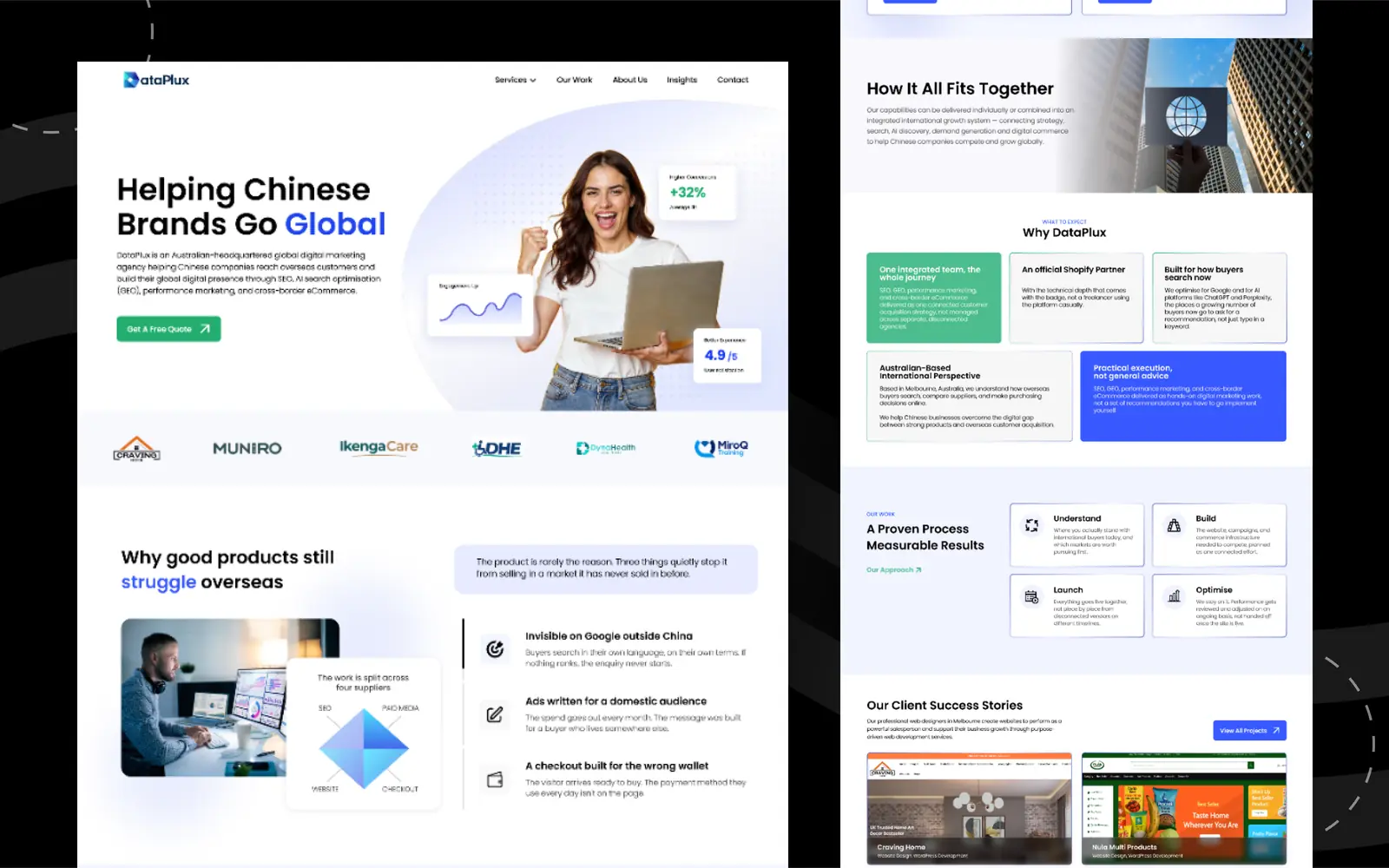
DataPlux home page: the overseas visibility problem named before any service is sold

DataPlux is an Australian digital marketing agency whose entire business sits in one gap. A Chinese manufacturer’s digital presence is built for Baidu and for domestic customers. The overseas buyer evaluating that manufacturer uses Google, reads English, and increasingly asks ChatGPT for a shortlist before opening any company’s website at all.

That gap is also the brief. The site sells to Chinese decision-makers, about buyers those decision-makers have never met. Every screen had to make an absent third party feel real — in a second language, to readers who mostly believe their product is already good enough to speak for itself. About the product they are usually right. That is the whole difficulty.

The whole site rests on one claim: the overseas buyer reaches a decision before anyone at the factory hears from them. That claim is measurable, so I checked it before designing against it.

The journey
B2B buyers now complete roughly 80% of their evaluation before contacting a supplier, and about two-thirds say they would rather buy with no sales rep involved at all. Whatever the website fails to answer, no one gets a second chance to answer it. That is the argument for opening on the diagnosis instead of a service grid.
Shortlist
94% of B2B buyers used AI somewhere in their most recent purchase; 72% use ChatGPT to evaluate vendors and 44% use Perplexity while shortlisting. The average shortlist has contracted from about 3.2 names to 2.5. Fewer slots, decided earlier, in a place the supplier cannot see.
The gap
Around half of B2B technology brands have no citations at all across ChatGPT, Perplexity and Gemini. Being absent from the assistant is now a way to lose before the site is ever loaded — which is why AI search optimisation sits beside SEO as a service of its own here, and why naming the platforms was the honest move rather than the risky one.
The reader
Google is unavailable inside China and Baidu holds over 70% of domestic search. A Chinese manufacturer’s entire digital presence — hosting, content, keywords, wallet — is therefore tuned to an engine its overseas buyer never opens. The invisibility is structural, not a failure of effort, and the page had to say so without insulting the reader.

Desk research on the market the site argues about, not research with the site’s actual reader. That second gap is named at the bottom of this page. Sources: Gartner on rep-free buying, G2 on AI-first vendor research, Baidu and Google in Chinese B2B search.

Decisions · 01

Open with the diagnosis, not the capability list

Chose
The first thing under the hero names three specific failures: invisible on Google outside China, ads written for a domestic audience, and a checkout built for the wrong wallet.
Rejected
The standard agency opening — a grid of services with an icon each.
Why
The visitor arrives believing the product is fine, so a service grid answers a question they have not asked yet. Naming the failure in their own terms is what earns the right to sell anything after it.
Evidence
The agency’s own founding judgement, kept on the About page: the product usually isn’t the problem.
Decisions · 02

Let the buyer’s questions structure the service page

Chose
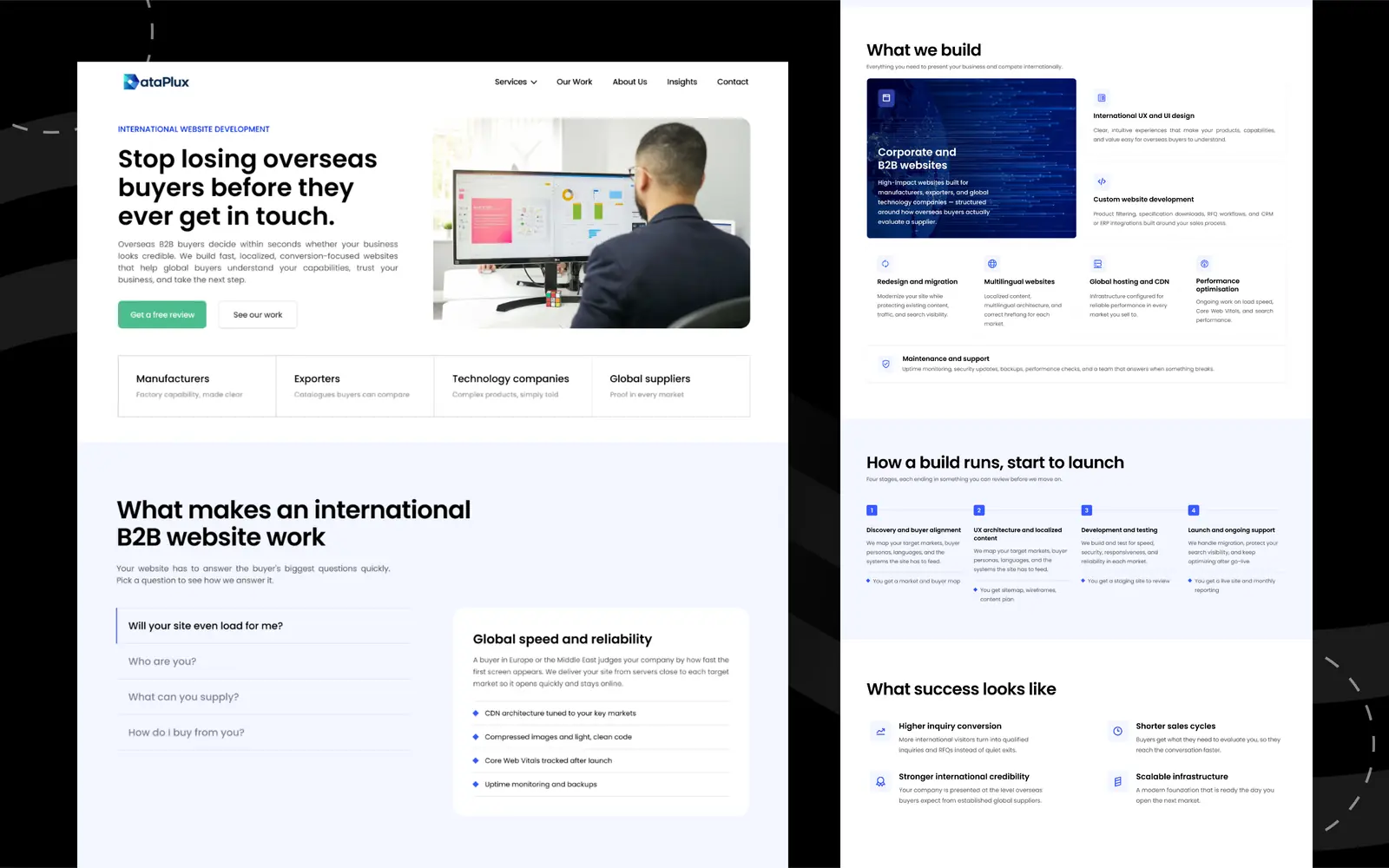
The website page is four questions in the buyer’s voice — will your site even load for me, who are you, what can you supply, how do I buy from you — and each answer is what gets built for it.
Rejected
A list of deliverables under a “what’s included” heading.
Why
A deliverables list asks the reader to imagine the value. Walking them through their own buyer’s visit instead makes the gaps surface on their own.
Evidence
They are collapsed by default, so the reader picks which to open, and each opens onto what gets built for it: CDN architecture tuned to the target markets, compressed images, Core Web Vitals tracked after launch.
Decisions · 03

End every stage in something the client can hold

Chose
The four build stages each close on an artefact: a market and buyer map, then sitemap, wireframes and content plan, then a staging site, then a live site with monthly reporting.
Rejected
A four-step process bar carrying verbs only — discovery, design, build, launch.
Why
This buyer has usually paid several vendors already and had no way to tell whether the work happened. A stage that ends in something reviewable is a stage they can audit. A verb is not.
Evidence
Every stage line opens with “You get”. The page never describes activity, only the thing that lands at the end of it.
Decisions · 04

Name the AI platforms out loud

Chose
The claim about how buyers search now states ChatGPT and Perplexity by name, and AI search optimisation sits beside SEO as a service of its own rather than a footnote to it.
Rejected
The safer, ageless phrasing — AI-ready, future-proof.
Why
Overseas buyers now ask an assistant for a shortlist before they open a supplier’s site. A claim that names the platform is one the reader can check tonight. AI-ready cannot be checked at all, which is exactly why every competitor can say it too.
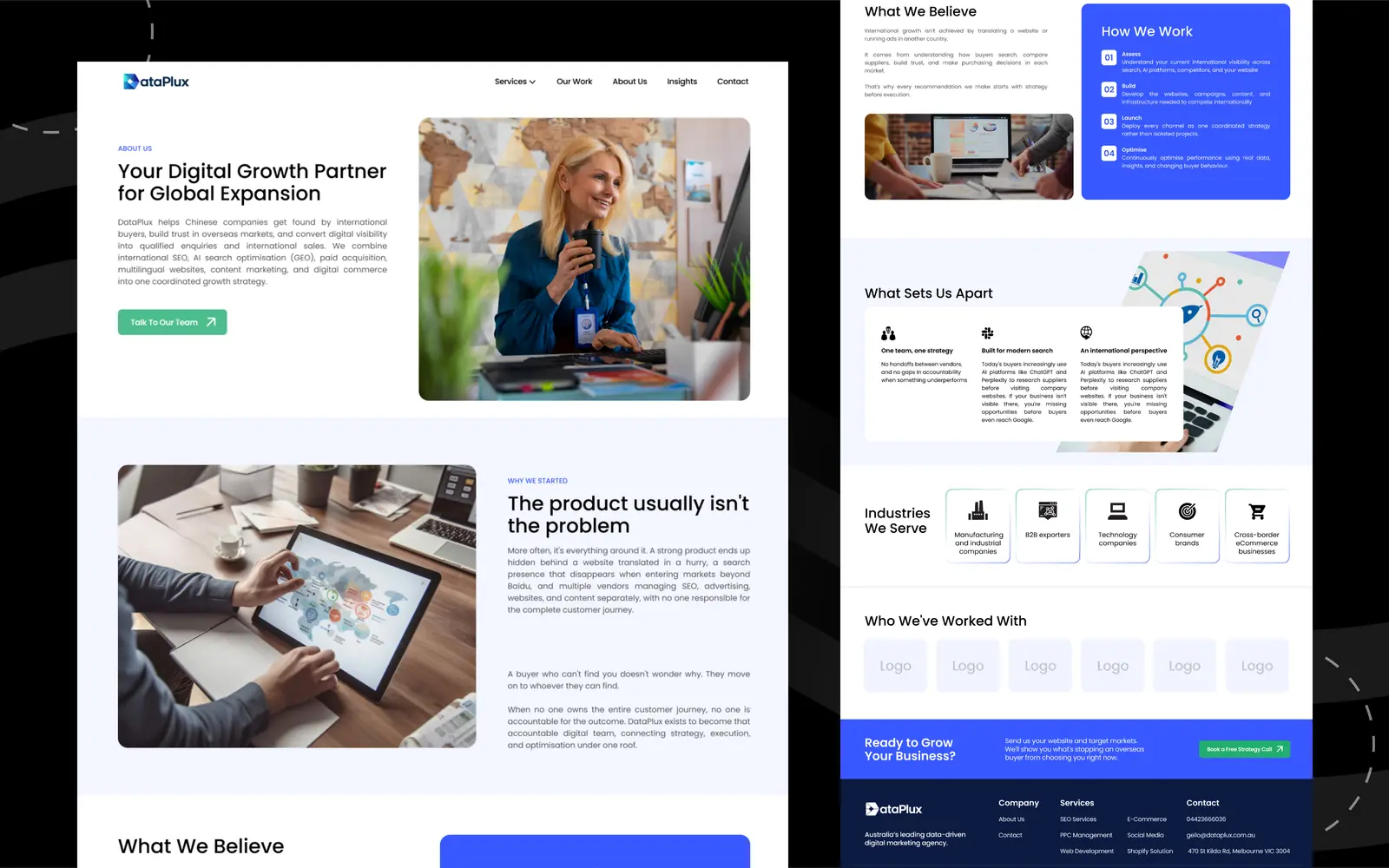
DataPlux About page, with the founding argument set as the headline
The About page puts the agency’s own judgement in the middle of the screen rather than in a mission statement at the bottom.
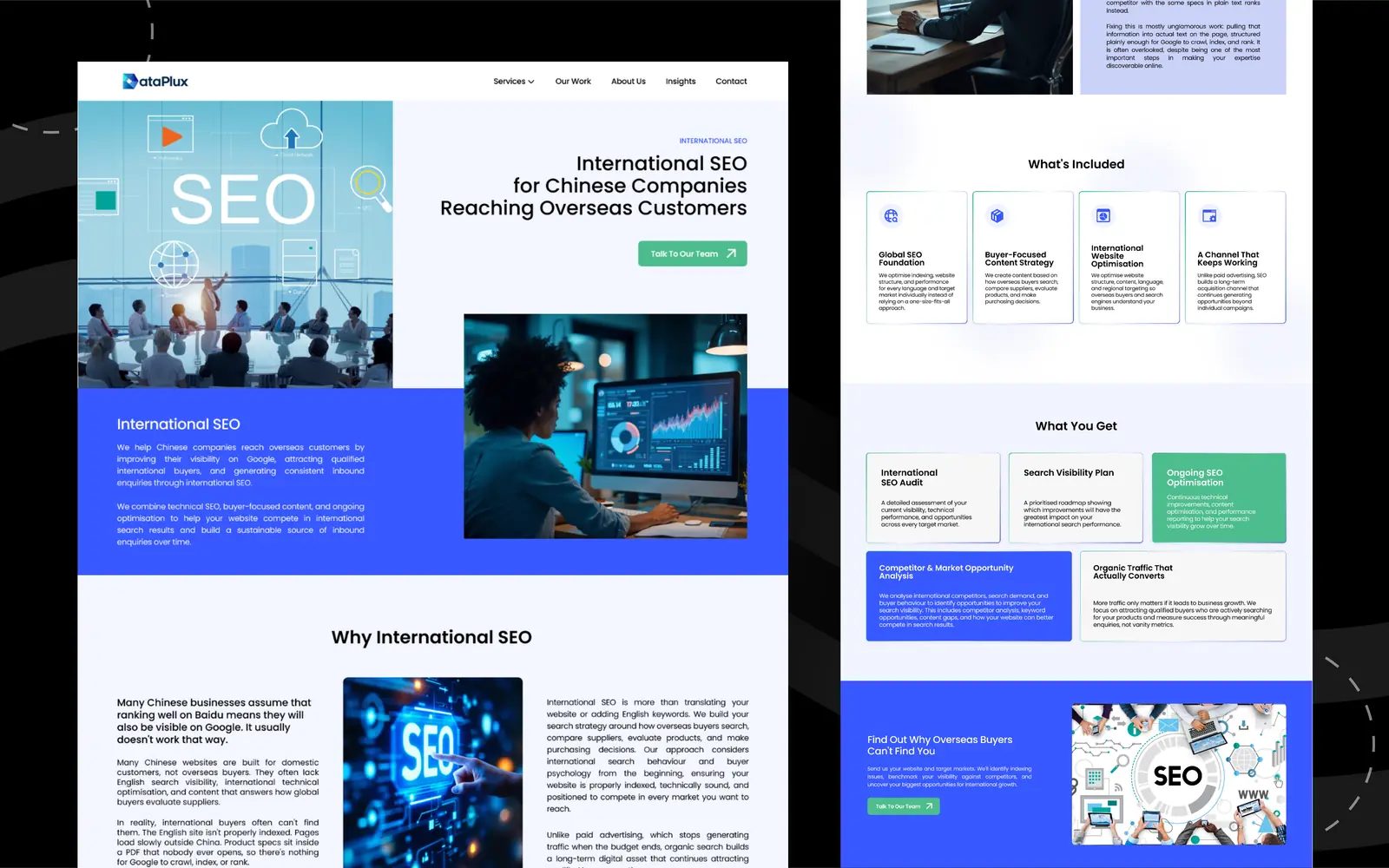
DataPlux International SEO service page
The International SEO page opens on the misconception it exists to correct — that ranking on Baidu carries over to Google.
DataPlux international website development page, showing the buyer-question accordion
The website development page, organised by the buyer’s four questions instead of by a list of deliverables.

The site argues well and I cannot yet prove it converts. Nothing here has been tested with the reader it was written for — an export manager reading English under time pressure — and that reader is the assumption the whole structure rests on. The two figures in the hero, +32% and 4.9 out of 5, are the client’s numbers rather than results I measured, and the page presents them as the client’s. Before I would defend the question order on the website page, I would want interviews with five of DataPlux’s own clients.