← All work

Funglish

A study abroad consultancy sells a conversation, not a catalogue. I designed the site around the decision a student is actually making.
Client
學晟有限公司 (Funglish)
Role
Website Design
Scope
Information architecture, home, application process, destinations, Q&A, student stories
Outcome
The live site the consultancy runs on.
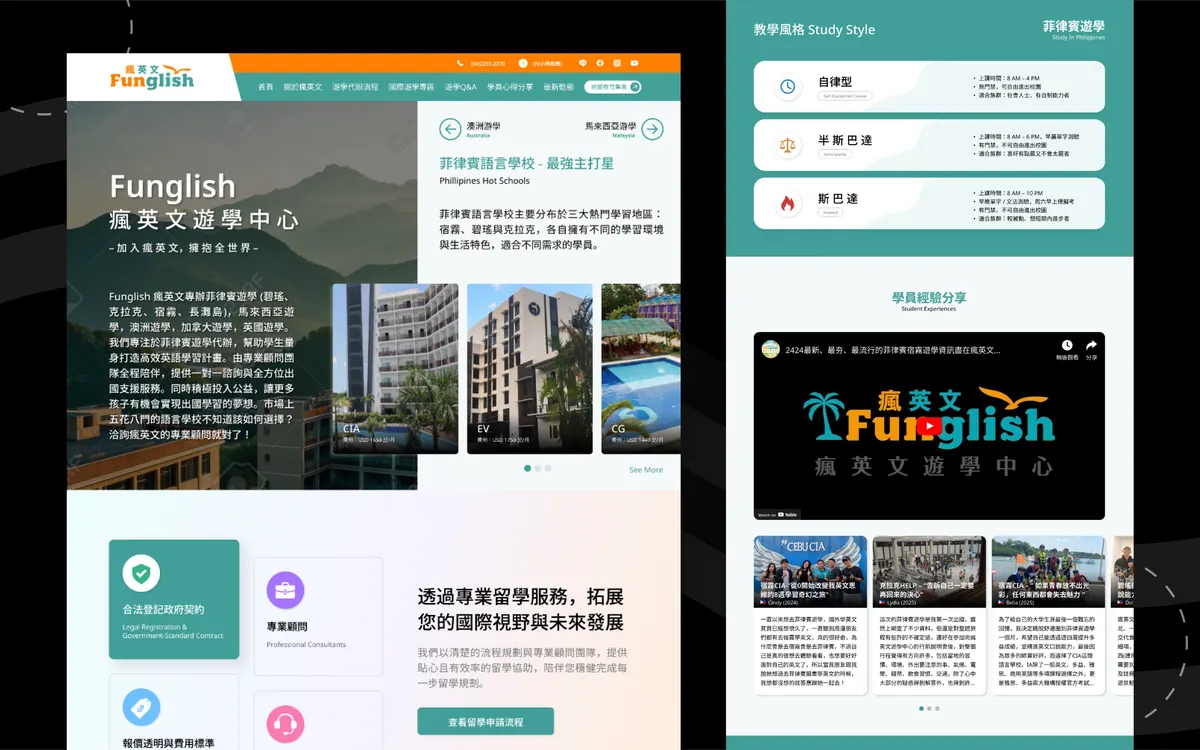
The Funglish home page: destination switcher, Philippines school cards and the study-style comparison

Funglish has placed students into language immersion and study abroad programs since October 2017 — the Philippines first, in Cebu, Baguio, Clark and Boracay, then Malaysia, Australia, Canada and the UK. Its customers are families making an expensive, once-off decision in a language that is often not their first. The old site listed programs like products, which misrepresented how the service actually works: nothing is bought off a shelf, and every plan is built in a consultation.

Five things about this market that the structure had to answer to. None of them are Funglish’s opinion about itself — they are the conditions the site was built inside.

Market
The Philippines is Taiwan’s largest language-travel destination — around 15,000 Taiwanese language students in 2024, in a market that barely existed ten years earlier. Cebu, Baguio, Clark and Boracay are exactly where Funglish places students, so the site is competing inside a crowded, fast-grown category rather than explaining a novelty.
Who decides
Parents sponsor the large majority of these trips and are usually the ones evaluating the agency; the student is the one who has to survive the program. Agents are a primary resource for both, which is why the service is a conversation rather than a transaction — and why a catalogue would have described the wrong business.
Stay
Four weeks is the most common length. Short, intense and expensive. Over four weeks the variable that decides whether the money worked is how hard the student was pushed, not how much the week cost — which is the argument behind ordering the comparison by intensity.
Vocabulary
Sparta, Semi-Sparta and self-disciplined are the Philippine ESL industry’s own categories, defined by daily class hours, mandatory evening self-study and curfew. Naming them on the site was not branding. It let families compare Funglish against every other agency in terms they were already using.
Trust
Since 2019 the Philippine Education Consulting Association has certified Taiwanese agencies and audited partner schools on site. In a market under that kind of scrutiny, registry listings, certificates and clear pricing are what separate agencies — and vague support descriptions and unqualified outcome statistics are the recognised red flags. That is why the proof and the scholarship work were given real estate instead of a footer line.

Desk research: published market data plus the client’s own operating knowledge, set down so the reasoning above can be checked. I did not run interviews on this project — that gap is named at the bottom of this page. Sources: ICEF Monitor on the Taiwan market, PECA Taiwan, Amerigo Education on how parents evaluate agencies.

Decisions · 01

Structure the site as a decision, not a catalogue
Chose
A sequence that follows the student's real question order: where do I want to go, what kind of program fits me, what happens after I say yes. The navigation carries that order — destinations, then the application process, then Q&A, then student stories.
Rejected
A program listing with filters and prices, the obvious e-commerce pattern.
Why
Funglish doesn't sell packages. It sells a personalised plan built in a one-on-one consultation, so a catalogue would have promised a product that doesn't exist.
Evidence
The navigation runs 首頁 → 關於瘋英文 → 遊學代辦流程 → 國際遊學專區 → 遊學Q&A → 學員心得分享 — the student’s question order, not a list of services.
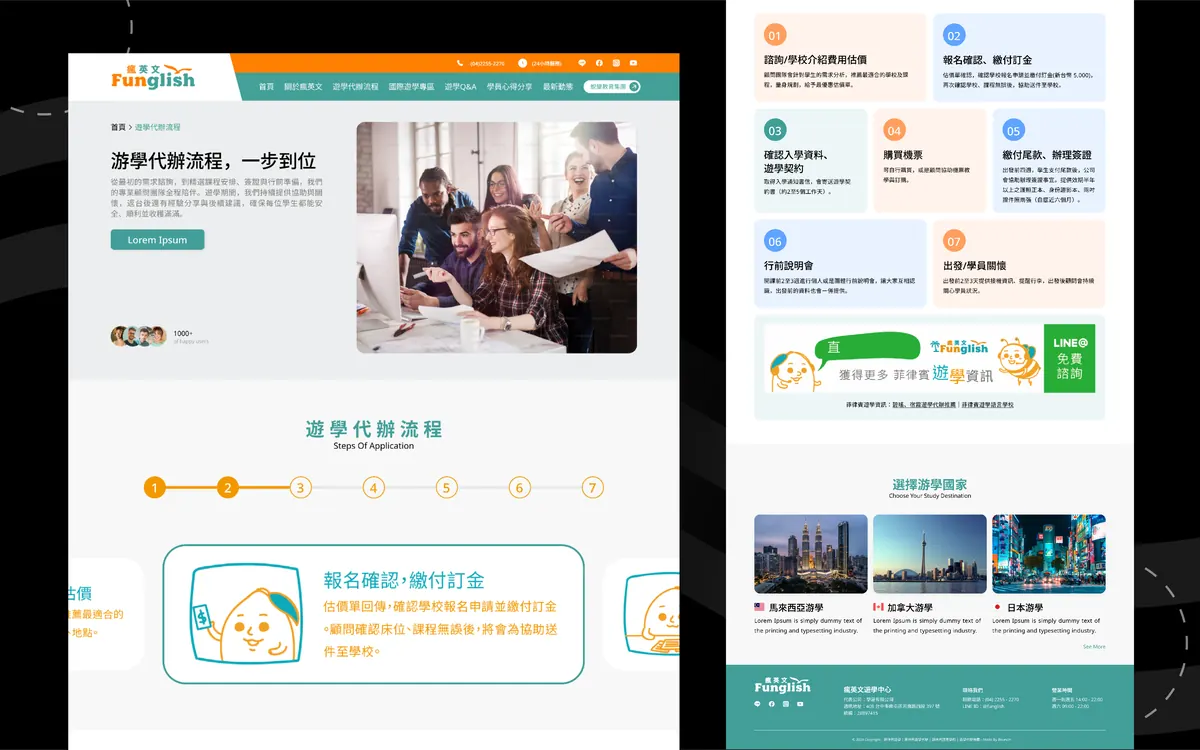
The seven-step application flow, from the first quote through to post-arrival check-ins
Seven steps, with the numbers named on the page: an NT$5,000 deposit at 02, the contract in two to five working days at 03, the balance four weeks before departure at 05. Steps 06 and 07 come after the money — a briefing, then check-ins once the student lands.
Decisions · 02

Let students compare by intensity, not by price

Chose
Three named study styles — Self-Disciplined, Semi-Sparta and Sparta — each spelled out by daily hours, curfew, testing and the kind of person it suits.
Rejected
A price-per-week table, which is how most agencies ask you to choose.
Why
What decides whether eight weeks abroad works is how hard a student is willing to be pushed, and how much freedom they will trade for it. Price tells you what you can afford, not what you can survive.
Evidence
Each style names hours, curfew, testing and the person it suits: 8 AM to 4 PM with the freedom to leave campus, through to 8 AM to 10 PM with tests morning and night and a Saturday mock exam.
Decisions · 03

Give the scholarship work real estate, not a footer link

Chose
A visible section on the organisation's work supporting underprivileged children into international education.
Rejected
A single line in the footer, where this kind of content usually ends up.
Why
It's a real reason families choose Funglish over a larger agency. Burying it would have wasted the strongest trust signal the organisation has.
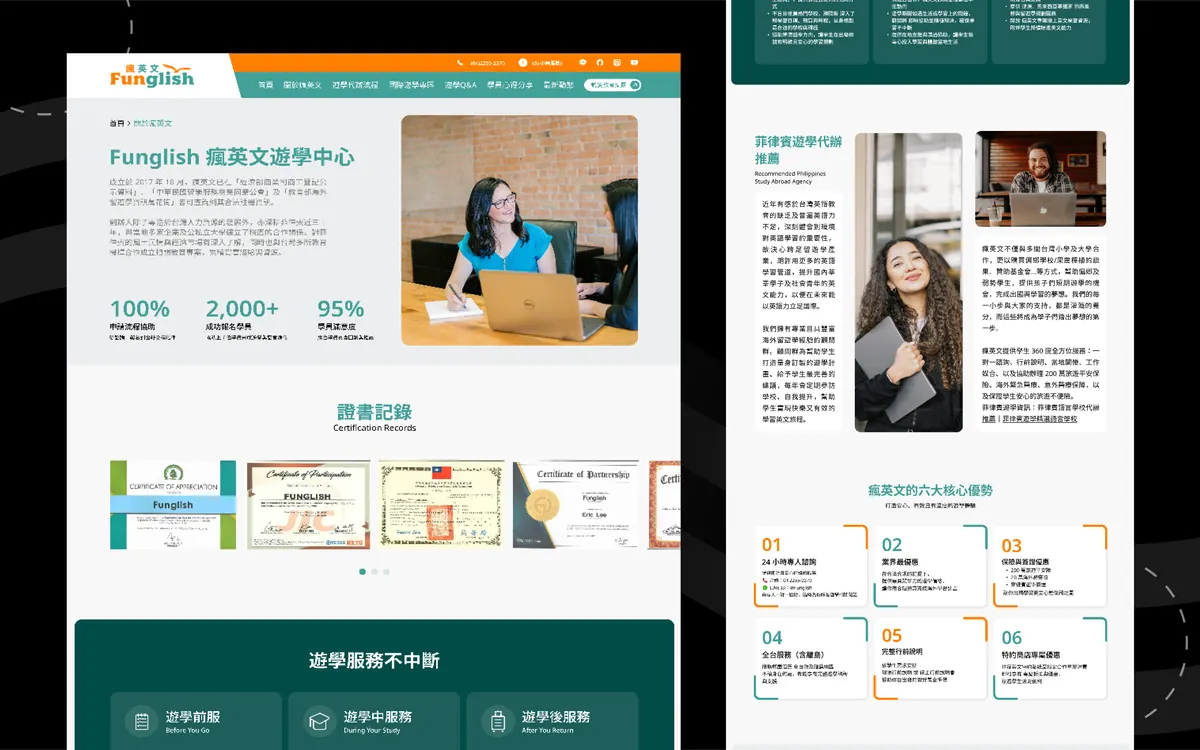
The About page: founding date, outcome figures, certification records and the three-phase service
Proof a family can go and verify: the October 2017 registration, the three public registries the company is listed in, the certificates, and a service split into before, during and after the trip.
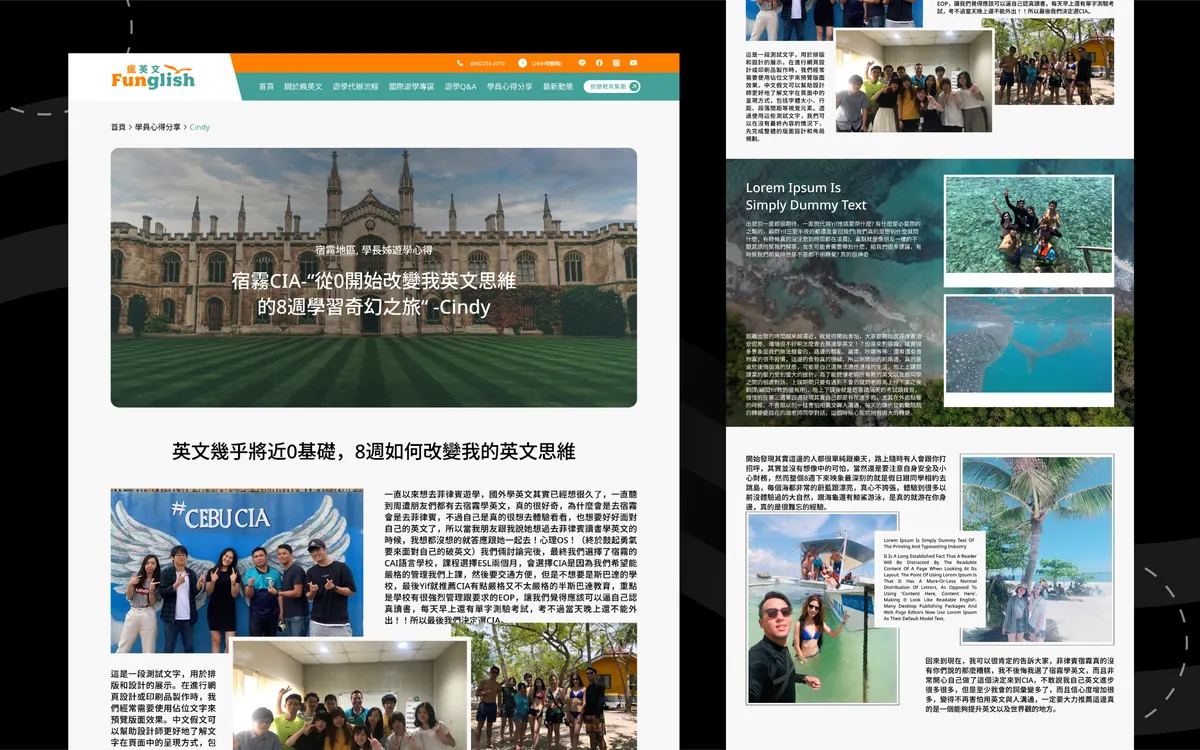
A student story page: Cindy’s eight weeks at CIA Cebu, told as a long-form article with trip photographs
Student stories run as full articles, not a testimonial slider. Cindy’s eight weeks at CIA Cebu get photographs and room enough to sound like a person rather than a pull quote.

I designed for the student, but the people who actually open the site are often the parents paying for it — who sponsor the large majority of these trips — and they read differently. If I started again I'd design the first screen for two readers at once instead of assuming one.